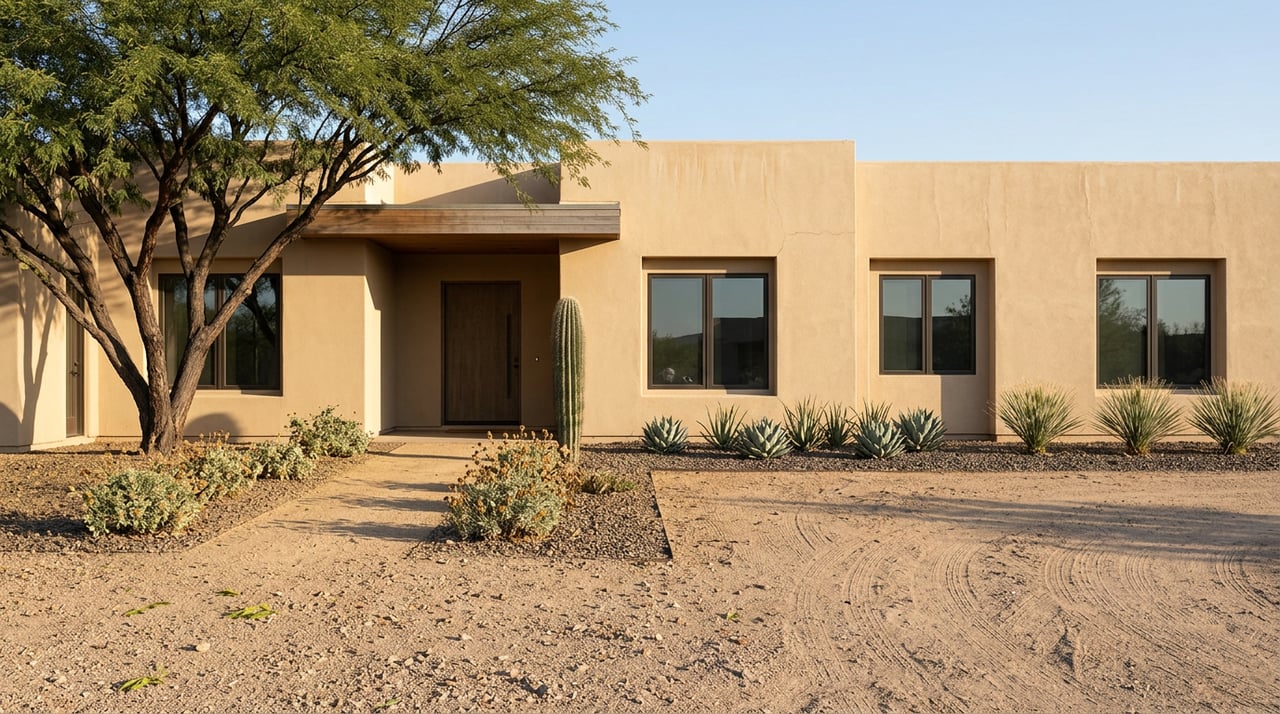
Picture two houses in Vail, a half mile apart, both listed in the same price bracket, both drawing water and disposing of waste the way most homes out here do. On paper, they look like the same transaction. They are not.
One has a septic system, so the seller is legally required to have it inspected before the sale can close, with a state form, a county fee, and a paper trail that follows the property. The other uses a private well, for which Well Water Testing says no water-quality test is required by law, unless a lender happens to ask for one. These are separate requirements, and a home can have both systems: septic inspection depends on the wastewater system, while well testing concerns the water source. Same market. Same season. Different due-diligence requirements.
That split is not a rumor or a quirk of one bad listing. It's built into Arizona law, and it shapes what due diligence looks like on almost every resale in this part of Pima County.
The Rule That Applies the Moment a Septic Tank Changes Hands
Arizona requires a Transfer of Ownership Inspection any time a property served by a septic system changes hands, under Arizona Administrative Code R18-9-A316. The seller is the one on the hook. Arizona's environmental quality agency puts it plainly: the inspection has to happen within six months before the property transfers, and it applies to conventional systems and alternative systems alike. This is not something a purchase contract can waive. The rule overrides any conflicting language the buyer and seller might try to write into the deal themselves.
In Pima County, which handles this locally rather than routing it through the state, the process runs through the county's own portal. The seller retains a qualified inspector, who fills out a Report of Inspection and hands it to the seller before closing. The seller submits that report through Pima County's Citizen Access Portal, which triggers a $50 invoice. After closing, the buyer has 15 calendar days to file a separate Notice of Transfer with Pima County's Development Services Department, a step that does not carry its own fee since the county's cost is already collected on the inspection side.
None of that is negotiable timing. It happens on every septic sale in Pima County, whether the house is a starter property or a foothills custom build.
A septic-served home is subject to a state-required inspection within six months before transfer. A private well has no state-required water test, though a lender may require one. A property can have both a septic system and a private well, so septic inspection and well testing are separate due-diligence matters.
The Rule That Doesn't Exist for Wells
Here's the other half of the split. Arizona has no law requiring a private well to be tested at the time of sale, or at any other time. Once it's operating, ongoing water quality testing is left entirely to the owner. The Arizona Department of Health Services recommends testing new wells for arsenic, nitrates, lead, and bacteria, and re-checking arsenic roughly every five years, but that guidance carries no legal weight. It is a suggestion, not a requirement, and nothing forces a seller to have ever followed it.
That matters more in Southern Arizona than it would elsewhere, because arsenic occurs naturally in groundwater across much of the state, and health officials have flagged it as a known concern in this region specifically. A buyer purchasing a well-served home in Vail can ask for a water test. But unless their lender requires it as a condition of financing, which FHA, VA, and USDA loans sometimes do, nobody is obligated to run one before the sale closes.
So the asymmetry is real: septic gets a mandatory, state-enforced look under the hood before every sale. Wells get a look only if somebody insists on it.
Why the Line Falls Where It Does in Vail
This isn't an abstract legal distinction. It maps onto actual geography in Vail. Vail Water Company is the private utility serving roughly 17,000 people through about 6,800 connections, and its service area has defined edges: Rex Molly Road to the north, Sahuarita Road to the south, Houghton Road to the west, and Lava Peak Road to the east. Vail Water has held an Assured Water Supply designation from the Arizona Department of Water Resources, good for 100 years, and has been blending in Central Arizona Project water with its groundwater supply since May 2015.
Inside that footprint, homes are almost certainly on municipal water. Outside it, in the surrounding unincorporated pockets that make up so much of greater Vail, a private well becomes the practical option, since there is no utility line to tap into.
The wastewater side follows a similar pattern. Pima County's Regional Wastewater Reclamation Department serves the bulk of the unincorporated county that sits within its sewer service area, but sanitation for the portions outside that footprint runs on individual septic tanks. Vail sits largely in that outside-the-sewer-line category, which is exactly why the septic Transfer of Ownership rule comes up on so many Vail sales in the first place. It isn't an edge case out here. It's closer to the default.
Put those two systems together and you get the split described above. A given Vail address might be on utility water and septic, on a private well and septic, or in some pockets, on utility water with sewer nearby. The paperwork obligations at closing depend entirely on which combination applies, and that combination depends on exactly where the parcel sits relative to Vail Water's mapped boundary and the county's sewer service lines.
| Septic system (if present) | Private well (if present) | |
|---|---|---|
| Inspection or water test required by law | Yes, within 6 months of transfer | No state-required water test |
| Who arranges it | Seller | Nobody, unless lender requires |
| Governing rule | A.A.C. R18-9-A316 | None at state level |
| County fee | $50, paid at ROI submission | None |
| Post-closing filing | Buyer files Notice of Transfer within 15 days | None |
What This Means at the Table
For a buyer writing an offer in Vail, this changes the questions worth asking before the inspection period even opens. Ask whether the parcel falls inside or outside Vail Water Company's boundary. If it's outside, ask what the well's testing history looks like, since nobody was required to keep one current. Ask whether the seller has already scheduled the septic Transfer of Ownership inspection, since it has to happen regardless, and knowing the timing helps you plan around it rather than discovering it late in escrow.
For a seller, the practical move is to get the septic inspection scheduled early rather than waiting until an accepted offer puts a clock on it. Six months sounds generous until a buyer's lender starts asking questions and the closing date is three weeks out.
For anyone comparing a well-served home to a municipal-water home in the same price range, the fair comparison isn't just the listing price. It's what each seller is legally required to disclose before you own it, and what you'd need to ask for yourself if the answer isn't already sitting in a file.
A Few Quick Answers
Can a buyer waive the septic inspection requirement to speed up closing? No. The rule overrides conflicting contract language, so it applies regardless of what the purchase agreement says.
If a home is on a private well, is there any way to see its water quality history? Only if the seller has voluntarily tested and kept records, since the state does not require ongoing testing or reporting for private wells.
Does being inside Vail Water Company's service boundary guarantee a home is on sewer instead of septic? No. Water service and wastewater service are separate systems in Vail, so a home can be on municipal water and still rely on an individual septic tank.
Every Vail address carries its own combination of water source and wastewater system, and that combination changes what closing actually requires. If you're weighing an offer or getting ready to list, it's worth mapping out exactly which rules apply to your specific parcel before you're staring down a deadline. Reach out to Katie Gibbons and let's get that answered early. Let's Connect.
This article is general information, not legal, tax or financial advice. Consult a qualified professional about your situation.